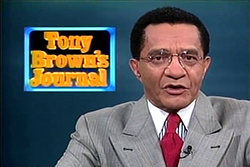
 Tony Brown, an influential television journalist, educator, and civil rights advocate whose groundbreaking work elevated Black voices in media and higher education for more than four decades, made his peaceful transition on June 17, 2026, at his home in Virginia. Widely regarded as a champion of truth, empowerment, and opportunity, Brown dedicated his life to the principle of “self-help” and the pursuit of excellence.
Tony Brown was also a prolific author, keynote speaker, and media entrepreneur. His work consistently emphasized empowerment through knowledge and accountability. He was the recipient of numerous honors—including Educator of the Year, Communicator of the Year, and the Ambassador of Free Enterprise Award. Brown built a lasting legacy as a trailblazer in both media and academia.
Born William Anthony Brown in Charleston, West Virginia, Brown was a proud graduate of Garnet High School, an all-Black school that helped shape his life and the lives of many future leaders. His primary education at Garnet formed the foundation of a life devoted to learning, leadership, and service. Brown carried those early lessons with him throughout his life. At Garnet, he joined the track team and excelled academically, especially in English and drama. He performed in school plays and, shortly before graduating in 1951, performed segments of Shakespeare’s Julius Caesar on WGKV radio in Charleston.
After completing his military service in the U.S. Army from 1953 to 1955, Brown enrolled at Wayne State University in Detroit, where he studied sociology and psychology and earned a bachelor’s degree in 1959. Motivated by a deep concern for the effects of poverty on African American communities, he continued his education at Wayne State. He received a master’s degree in Psychiatric Social Work in 1961. He briefly worked as a social worker, deepening his understanding of people, communities, and the challenges they face. Brown was also a devoted member of Alpha Phi Alpha Fraternity, joining a brotherhood known for scholarship, leadership, and civic engagement.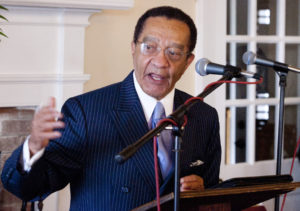
In 1962, Brown turned to journalism, joining the Detroit Courier as a drama critic. He quickly rose to the position of editor, establishing himself as a prominent voice in the city’s media landscape. In 1968, he left the newspaper to pursue a career in public-affairs broadcasting at WTVS, Detroit’s public television station.
Over the next three decades, Brown became a pioneering figure in television programming focused on Black audiences and issues. At WTVS, he produced Colored People’s Time, the station’s first program specifically aimed at a Black audience, as well as Free Play, another community-centered show.
Activism was central to Brown’s work. In addition to maintaining a strong presence in community-oriented programming, he launched initiatives aimed at advancing economic and educational opportunities for African Americans. Called “Television’s Civil Rights Crusader” in a cover story by Black Enterprise magazine, Brown also played a significant role in the civil rights movement. This self-help proponent coordinated a Detroit march in 1963 that featured Martin Luther King, Jr. and, according to Business Week magazine, drew an estimated 500,000, perhaps the largest civil rights march in America. It is also believed to be the first time Dr. King delivered his famous “I Have A Dream” speech. USA Today selected Brown as one of the top five leaders to analyze the status of Black America.
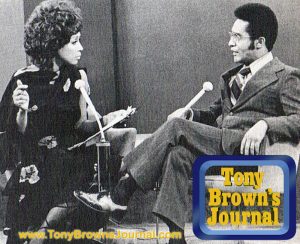 Best known as the longtime host and executive producer of the award-winning television program Tony Brown’s Journal, Brown became a central figure in American broadcasting history. In 1970, he was named executive producer and host of Black Journal, a New York-based public television program that had debuted two years earlier and aired nationally. The program combined commentary, documentaries, and public-opinion segments.
Brown’s tenure at Black Journal was often controversial. His forthright criticism of the U.S. government’s impact on African American life, along with his uncompromising editorial style, drew criticism from both broadcasting circles and segments of the Black community. In 1973, the Corporation for Public Broadcasting announced it would withdraw funding for the program. The decision prompted protests from across the country, and Black Journal continued to air, albeit on a limited basis.
In 1977, Brown secured a sponsorship agreement with the Pepsi-Cola Company, relaunching the program as Tony Brown’s Journal and moving it to commercial television. The show returned to public television, where Brown hosted the nationally syndicated series for 40 years. The Emmy-nominated program became the longest-running series in the history of PBS and was ranked among the top 10 television shows of all time, presenting positive Black images by the New York Daily News. Tony Brown’s Journal is an irreplaceable primary record of African American opinion and experience.
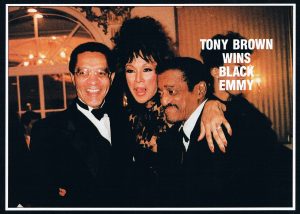 The TV series received the l991 NAACP Image Award for “Outstanding News, Talk or Information Series/Special.” Even before Tony Brown retired the Emmy-nominated, award-winning series in 2008, it had become the longest-running series in the history of the PBS network and in 1979, it was, according to the A. C. Nielsen Company, “the #1-Rated Syndicated Talk/Educational National TV Series.”
Tony Brown’s influence extended far beyond the television screen. He was a passionate educator, he served as a professor at Central Washington University, Federal City College, Howard University and Hampton University. Brown helped shape the next generation of journalists. In 1971, he founded the School of Communications at Howard University in Washington, DC and served as its dean until 1974. In 1980, he founded Black College Day, an effort to encourage students to consider HBCUs and preserve those important institutions for generations to come. The U.S. Congress officially designated the last Monday in September to honor that observance. He also founded the Council for the Economic Development of Black Americans, whose “Buy Freedom” campaign urged support for Black-owned businesses – even creating Freedom Dollars. To address the issue of drug addiction, he wrote and produced the film The White Girl.
In 2004 he returned to academia as the first dean of the Scripps Howard School of Journalism and Communications at Hampton University in Virginia, a position he held until 2009. In 2012, Brown was inducted into the Scripps Howard School of Journalism and Communications Hall of Fame in recognition of his leadership in transforming the school into one of the nation’s top journalism programs.
In addition to his television work, Brown hosted influential radio talk shows in New York (WLIB) and Chicago (WLS),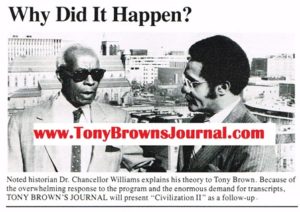 connecting with listeners in a more personal way. Talkers, the prestigious radio trade magazine, named him one of the 100 most important radio talk show hosts in America. His contributions were further recognized with his 2002 induction into the National Academy of Television Arts & Sciences Silver Circle and as part of the National Association of Black Journalists’ 40th Anniversary Gala, NABJ was pleased to announce Tony Brown as one of its 2015-2016 Hall of Fame Inductees.
Beyond writing a widely syndicated newspaper column, Brown was the author of several books, including Black Lies, White Lies: The Truth According to Tony Brown (1995), Empower the People: A 7-Step Plan to Overthrow the Conspiracy That Is Stealing Your Money and Freedom (1998), and What Mama Taught Me: The Seven Core Values of Life (2003).
Even after stepping away from Tony Brown’s Journal in 2008, Mr. Brown continued to share his work through an extensive archive available around the world, ensuring that the stories, interviews and history he preserved for more than 40 years would remain accessible for future generations. The archive contains original interviews, commentary, and documentary material capturing voices, movements, and perspectives that cannot be recreated today. Because of its uniqueness and irreplaceability no modern production can reproduce the original subjects, timing, or authenticity embedded in these recordings.
Tony Brown leaves behind a legacy and life defined by education, service and an unwavering belief in telling the truth. His influence will continue to resonate through the institutions he shaped, the voices he amplified, and the generations he inspired. Brown, in the community he called home in his later years, will be remembered not only for what he accomplished but for the example he set.
Brown’s work as a broadcaster, educator and activist helped reshape how African American life and issues were represented in American media, opening doors for a generation of journalists and producers. His insistence on addressing racial inequality and economic empowerment left a lasting imprint on public discourse and on the institutions he helped build.
Despite his national recognition, those closest to him remember a man grounded in simple but powerful principles that guided both his professional work and his daily life. His personal mission statement: Diversity Through Excellence. His call to action: Self-Help. His motto: No Black Lies. No White Lies. Only the Truth.
###
Rest Well With The Ancestors
June 26, 2026